
 Joseph W
Joseph W

March 2024
(last updated July 2024)
Joseph W. *(1)
Portrait taken by his girlfriend.*(2)
Age: 21
Josepeh is currently studying towards a Masters Degree in Civil Engineering at the University of Sheffield.
He has been doing digital photography for close on a decade up to 2021, but on impulse he bought a Minolta X-500 from an Oxfam in 2021 during the tail-end of the Covid lockdowns, after getting hooked on the whole “analogue” trend on the Internet.
"It’s still my favourite film camera, and I’ve now amassed quite a collection of accessories for it as well as getting obsessed with other Minolta cameras - they were a pretty cutting-edge manufacturer for a long time, and they got real weird with it at times…"
"I'm absolutely in love with black-and-white films - I’d say they make up 80-90% of what I shoot - partly because I can develop them myself in the darkroom, and partly because of the range available and the amount you can play with them"
Films used
Rollie Infrared black and white film
Joseph took these images in Padley Gorge, and around the Hathersage area. (Jen: I recognise that pub car park, 'The Millstone', near 'Surprise View', on the road leading into Hathersage. Had many a meal and ocassional drunken stumble in there myself lol).
Jospeph developed the film himself. It was pretty dull weather conditions that day, but now he has more experience of this film, he has ordered more and is going to try again in sunnier conditions in the hope of better, improved results. Here's these for now:


Harman Phoenix 35mm colour
"Here's a few shots from a new roll of Phoenix that I've just put through my new Nikon F90x:"


lford HP5+

Joseph says:
"This one I just impulse took on a walk through the Uni campus: I thougt it might be interesting, the contrast looked fun. When I developed it I was honestly surprised by how well it came out- there's just something about the angularity of the stairs that I realy enjoyed. Which is weird, given that it is, at heart, just a photo of some stairs."
Ilford XP2

(Jen - I recognise this hotel - It was on an episode of the Hotel Inspector! featuring a rather grumpy owner as I recall..).

"Taken on a trip to Wales in late November, I stood next to this boat on a muddy beach for about ten minutes waiting for the conditions to line up to get the right level of contrast for this shot. My girlfriend *(2) thought I was mad.."
Ilford HP5+
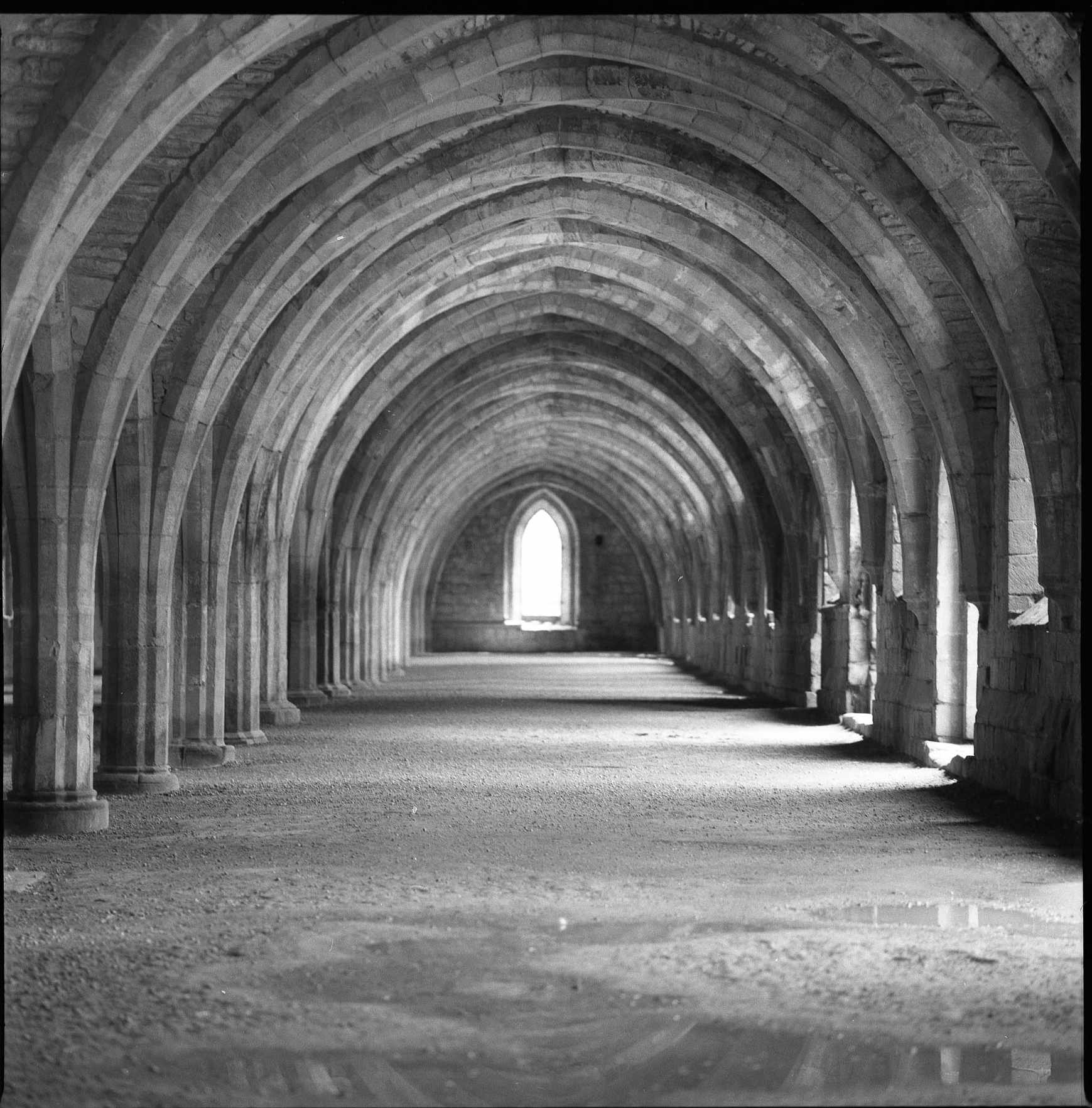
"This is inside te cloisters at Fountains Abbey. I realy like architechtural shots, which is partly why I bought a medium-format (120mm) Bronica S2A last year." I wanted to be able to get higher-detail shots that I could enlarge more without the grain becoming an issue.
I really like the repeating forms of the ribbed arches going off down the shot, and the fact that I managed to get it without any people in it! ."
Ilford XP2
"I took this on a trip to Wales in late November, and I realy like the way the lower winter sun gave this stark high-contrast look across the face of the building".
Ferrania P30 ultra-low ISO

"This is Bamburgh castle in Northumberland - I was testing out a roll of a new emulsion while I was there, the Ferrania P30 ultra-low ISO film from the Italian manufacturer Film Ferrania." *(4.)
"It’s a rebooted version of a filmstock that many Italian films of the ‘60s were shot on and was a particular favourite of Federico Fellini. It’s designed to be ultra-high contrast, something that I particularly love in black-and-white, and that’s very apparent in this shot. I really like the way the castle itself is basically reduced to a silhouette looming over the beach in front."
Expired Gold 200
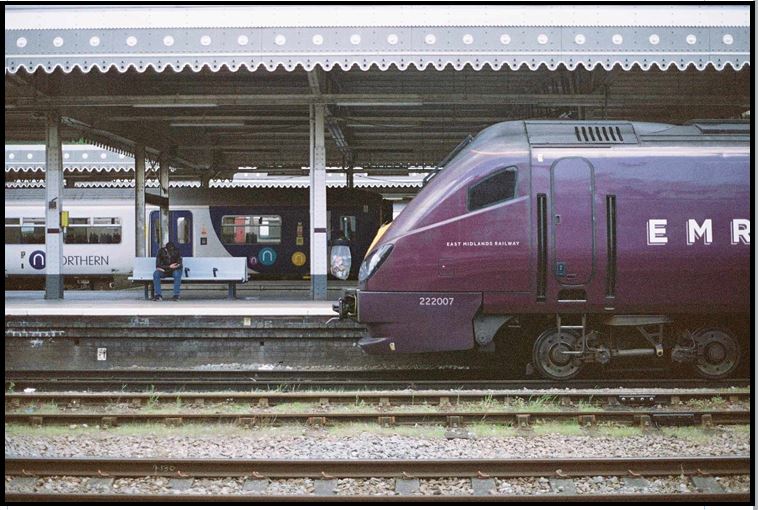
"One of my rare colour photos, this was shot on (very) expired Kodak Gold 200 film, exposed at 100ISO. It was expired enough that the packaging still said: "Kodak - Sponsor of the Olympic Games" - It should have been used before 2002!" *(3)
"I really like the framing of this one between the size of the train and the man on the bench next to it."
Ilford Delta 3200 ISO

"This was taken last December at about 10pm. t was completely dark, and I had been trying a roll of Ilford Delta 3200 at the Christmas markets in the city centre. Most of the shotswere not great".
"I decided to try and see if I could get a sort of long-exposure shot of the cars on the ring road, given that this was probably the only time I’d have a fast enough film to do this without a tripod. It came out far better than I expected, and I mean to try it again at some point - just as soon as I get my hands on another roll of Delta 3200…"
Harman Phoenix 200 ISO

"The film I've probably been most excited for, ever! This was shot on Harman Photos' new emulsion, 'Phoenix' film. It's a 200 ISO colour negative film that is, by Harmans' own admission, 'very experimental'. It's got very limited exposure latitude, high contrast, high grain.. and I absolutely love it!".
A lot of the colour films available now were re-designed for digital scanning in the 90s, and so while they’re very 'accurate', I find that they’re almost too clinical. They’re boring! This one’s weird, kinda technically 'bad', and I think that makes it much more interesting."
-------------------------------------------------------------
At this point, this is all Joseph has said. BUT... you cannot escape the 'Sheffield Inquisition' that easily!
------------------------------------------------------------
A few more questions Joseph!
Where are you from originally?
"I'm from Suffolk".
What about any childhood influences that have shaped your photography?
"Mostly pulled a lot from paintings and landscapes, especialy a lot of inspiration from landcsape photographers like Ansell Adams".
What excites you about film?
"I like the delayed gratification of not knowing how the photos are going to come out when you take them on film. I like that a different film stock can give you a totally different look without the need for any editing afterwards."
Your prediction for the furure and longevity of film use?
"I think film has a long future as long as people keep shooting with it. There'll always be a niche that film fulfills better than digital".
Relating to film camera users, what is Sheffield missing?
"Some sort of community darkroom would be fantastic. I'm lucky to have one available through the Uni 'Photographic Society of Sheffield', but I think it would be fantastic if there was a bigger community space for the wider bfilm community of Sheffield, especialy families".
And what do you think is good about Sheffield?
"The range of independant shops and developers - Harrisons, J+A, and yourselves - I think we're very privilidged to have so many local options".
Joseph, have you a favourite film camera?
"yes, my Minolta X-500, by a long shot. But I'm biased, because it's been with me through a lot. It's taken some of my favourite photos and it's never let me down. I'd realy like a Nikon F5 though....".
Music of choice?
"Oh, it covers a massive spectrum: Pop-punk, Midwest emo, classic rock. I'm a big fan of 'Modern Baseball' and 'Slaughter Beach', 'Dog'.. But also Springsteen, Blue Oyster Cult. Also, Squeeze, The Cure, Jefferson Airplane Dr Hook... it goes on forever!".
Your favourite local place to eat out?
"Piccolinis in town. Really good classic Italian".
Favourite films?
"If I had to do the Letterbox thing and just do four? 'Blade Runner', 'Ferris Buellers Day Out', 'Euro Trip, and 'Four Weddings And A Funeral."
Which cameras have you used, and how do you rate them?
"You've already heard me rave enough about my Minolta X-500. I love my Bronica S2s - meduim format is a beautiful experience. I've just aquired a 4X5 large format Toyo-View too. I still have my Minolta 7000AF - the first proper autofocus SLR. I've found that I don't enjoy the autofocus experience as much as I thougt I might though - the whole electronic control interface takes away from the analogue experience in my experience. If anything I probably have too many cameras and I'm looking to slim it down, but it's hard to part ways.."
For more on Joseph
I've given Joseph a roll of Rollie Infrared film to trial for us. Should see the results on this page soon.
You can see more from Joseph on Instagram here.
Joseph is also the secretary of the Sheffield University Photographic Society. You can view their Instagram account here.
Jens thoughts
*(1) Joseph looks uncannily like my biology teacher, Mr Robinson, at secondary school in the late 1970's, in terms of hair and moustache, shirt etc. On Social Media Joseph states: "I am the most 40-year-old 21-year-old you'll ever meet". I agree lol. Found this clip from a newspaper of Mr Robinson; he had obviously just had a lot of hair chopped off for the photographer though:
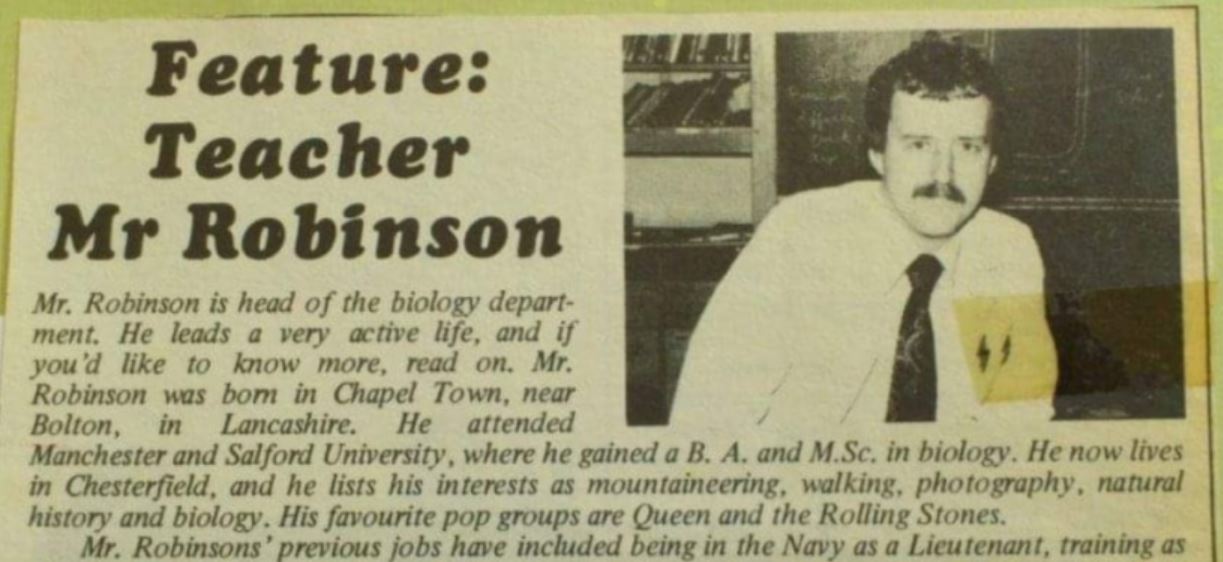
I will never forget him telling me I was crap at Biology in the 5th form, but I went on to get an 'A' at 'O' level and 'B' at 'A' level. So there. All blow a raspberry at him!
*(2) I notice TWO mentions you made of having a girlfriend, Joseph. From my perspective, it's OK everyone to be single and unloved, I mean, it's not that bad. Well, I enjoy it. Who cares if you eat a ready-made meal for two all by yourself? Anyway, my dog loves me. It's no big deal. Sniffle....
*(3.) Reminded me of around the mid 1990's, Kodak introduced a Kodak Gold offer to customers whereby if you saved three empty film boxes, you could get a free pizza at 'Pizza Hut'. In those days, people would dash in to the shop, ask you to put the film in for you, often dashing out again, leaving the Kodak film boxes behind them. Me and John toured about a 30 mile region around Sheffield, comparing 'Pizza Hut' experiences, and getting rather fat in the process. We were relieved when the offer ended to be honest!
*(4.) Film Ferrania- nope, never used this. Would like to see a few more shots on this film
Categories
- Shop history
- Jens Blog
- A study of Sheffield film camera users
- Articles on Sheffield bird watchers
- Developing of 35mm+ 120mm films
- Colour 35mm + 120mm analogue films
- Black and white 35mm and 120mm films
- Reprints/enlargements
- Scanning services
- Developing of E6 slide films
- Developing of: APS, 110mm, 126mm, 127mm, Panoramic and Half Frame
- Full size 42mm binoculars
- Medium sized 32mm lighter weight binoculars
- Compact, pocket-sized binoculars.
- Children's nature optics and accessories
- Monoculars
- Fieldscopes
- Action and Wildlife cameras
- Binocular and scope accessories
- Magnifiers and loupes
- Instant films and cameras
- Reusable 35mm cameras
- Disposable 35mm film cameras
- Picture frames
- Photo albums and storage boxes
- Analogue film camera accessories
- Gift ideas, gadgets and general accesories
- K+F Concepts camera bags
- Dick Smith camera bags
- Tripods
- Monopods
- Tripod heads
- Mini table top supports for cameras/phones/tablets
- Batteries and chargers
- Lexar Professional SDHC/SDXC
- USB's + Memory card readers
- Silicon Power SDHC/Micro SD and Compact Flash cards
- Filters
- Digital papers